Tiny Rails, Massive Passion: Why Grown Adults Are Going All-In on Model Trains
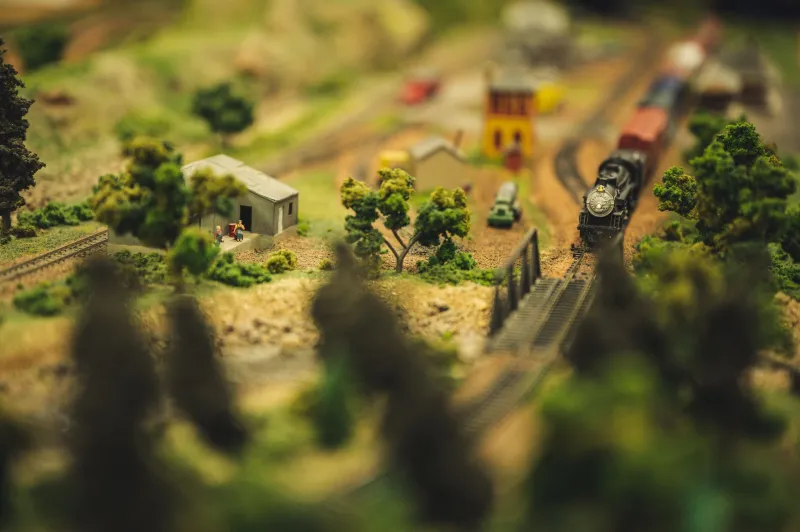
Walk into Gary Hutchins' spare bedroom in suburban Columbus, Ohio, and you might forget you're standing in a house. Stretched across a 12-by-16-foot table is a fully realized slice of 1950s rural Pennsylvania — rolling hills dusted with static grass, a working grain elevator, a diner with hand-painted signage, and a locomotive hauling coal through a papier-mâché mountain pass. Gary spent four years building it. He estimates he's invested somewhere north of $14,000.
"People think I'm nuts," he says with a grin. "But then they stand here and watch the train go around, and something happens to them. They go quiet. They just... watch."
Gary isn't alone. Across the country, a passionate and growing community of adults is rediscovering model railroading — not as a nostalgic throwback, but as a full-blown serious hobby with real craftsmanship, real community, and yes, real money involved.
Not Your Grandpa's Train Set
For a lot of people, model trains conjure up a specific image: a Lionel set circling a Christmas tree, maybe a dusty layout in some retiree's basement. That image isn't wrong, exactly — but it's wildly incomplete.
Today's model railroading scene spans multiple scales (HO, N, O, Z, and G scale being the most popular), a vast ecosystem of specialty manufacturers, and a collector culture that rivals vintage wine or rare sneakers in its intensity. Brass locomotives — hand-crafted, limited-edition models imported from manufacturers in Japan and Korea — regularly sell for $500 to $2,000 a piece. Serious hobbyists don't blink at those price tags.
The National Model Railroad Association (NMRA), which has been around since 1935, still draws thousands of members nationwide. But the real energy these days is happening online. Facebook groups, Reddit's r/modeltrains community, and YouTube channels dedicated to layout building have exploded in size over the last five years. One popular channel, run by a guy in Arizona who goes by "Layout Dave," has racked up over 300,000 subscribers just by documenting his ongoing HO scale layout build.
"The internet changed everything," says Karen Voss, a hobbyist from Portland, Oregon, who started building her N scale layout during the pandemic. "You used to have to find a local club to learn anything. Now you can watch someone in Germany wire a DCC decoder at midnight and apply it to your own layout the next morning."
The Psychology of the Miniature World
So what's the pull? Why are people who could be gaming, streaming, or doing literally anything else on a Saturday afternoon instead hunched over a workbench, tweaking the weathering on a 1:87 scale boxcar?
Part of it, hobbyists say, is control. Model railroading gives you a contained world where everything operates exactly the way you design it. You choose the era, the geography, the weather, the time of day. In a life full of chaos and uncertainty, that level of creative authority is genuinely satisfying.
There's also the meditative quality of the work itself. Scratchbuilding a tiny storefront or hand-laying a section of flex track requires a kind of focused attention that forces everything else out of your head. Hobbyists describe it in terms that sound almost like mindfulness — a deep, absorbing present-tense focus that's hard to find elsewhere.
And then there's the history angle. Many model railroaders are railroad history buffs who use their layouts to recreate specific prototype railroads — the Pennsylvania Railroad, the Santa Fe, the Southern Pacific — in their operational prime. The hobby becomes a way of preserving and interacting with history in three dimensions.
Conventions, Clubs, and a Surprisingly Tight Community
The social side of model railroading is one of its most underrated features. Regional train shows and conventions happen throughout the year across the US, from the massive National Train Show (co-located with the NMRA National Convention) to smaller regional events hosted by local clubs in VFW halls and fairgrounds.
These gatherings function part hobby swap meet, part art exhibition. Modelers set up portable "modular" layouts that link together into massive display railroads, while vendors hawk everything from vintage Lionel rolling stock to custom-laser-cut building kits. The vibe is genuinely welcoming — experienced hobbyists are almost aggressively helpful to newcomers, because the community understands it needs fresh blood to survive.
Local clubs remain a cornerstone of the hobby. Most mid-sized American cities have at least one, and many operate permanent club layouts in spaces they've rented or built out over decades. These layouts can be staggering in scale — hundreds of square feet of scenery, dozens of trains running simultaneously, with members showing up on weekends just to operate.
"It's like a second family," says Tom Brewer, a retired electrician from Nashville who's been a member of his local club for 22 years. "We've got guys in their 30s running trains next to guys in their 70s. Nobody cares about anything except the hobby."
The Investment Angle Nobody's Talking About
Here's where things get interesting for the financially minded. Certain segments of model train collecting have started to behave a lot like the broader collectibles market. Vintage Lionel prewar sets in original condition can fetch thousands at auction. Rare brass locomotives from out-of-production runs appreciate steadily over time, and a small but serious community of collectors tracks secondary market prices the way others track stocks.
This has brought a new kind of collector into the hobby — people who aren't necessarily interested in building layouts but who see quality model trains as tangible assets worth acquiring and preserving. It's a niche within a niche, but it's real, and it's added a layer of market sophistication to what was once purely a play-and-display hobby.
Most hardcore layout builders aren't thinking in those terms, though. For them, the value is entirely experiential. The hours spent building, the satisfaction of a finished scene, the simple pleasure of watching a locomotive roll through a world you created from scratch — that's the payoff.
Why Analog Wins in a Digital World
There's something almost counterintuitive about model railroading's staying power in 2024. We live in an era of photorealistic video games, virtual reality, and infinite digital entertainment. And yet people keep choosing to sit at a workbench, gluing foam rocks and painting static grass.
Maybe that's exactly the point. In a world where so much experience is screen-mediated and ephemeral, there's something deeply satisfying about making a physical thing — something you can touch, something that takes up space, something that will still be sitting there tomorrow exactly as you left it.
Gary Hutchins puts it simply as he watches his Pennsylvania Railroad freight train rumble through his mountain pass one more time: "When I'm in here, nothing else exists. That's worth every penny."
Hard to argue with that.